
The Clinical Expertise of Mr Marco Scarci in Thoracic Surgery
Thoracic surgery sits at one of the most technically demanding intersections of modern medicine. Operating on the lungs, chest wall, and surrounding structures requires not only exceptional surgical skill but also a nuanced understanding of complex respiratory physiology, oncological staging, and the long-term functional outcomes that matter most to patients. It is a specialty in which experience, academic grounding, and a commitment to innovation are not aspirational qualities but clinical necessities.
Mr Marco Scarci, a consultant thoracic surgeon based in London, has spent more than two decades building a career that reflects precisely those qualities. Holding the qualifications MD, FRCS(Eng), FCCP, FACS, and FEBTS, he is recognised within the specialty for his work in minimally invasive lung surgery, chest wall conditions, and cancer surgery. His profile spans clinical practice, academic research, and surgical education, and this review examines each of those dimensions in turn.
A Surgical Career Built on Precision and Purpose
From Central Italy to the World's Leading Surgical Centres
Mr Scarci grew up in central Italy, where an early exposure to medicine came through a close family connection: his uncle was a cardiothoracic anaesthetist. That formative influence guided his trajectory toward the operating theatre, and after completing his medical training in Italy, he pursued advanced specialist training that took him well beyond European borders. His commitment to understanding thoracic surgery at its highest level led him to undertake clinical fellowships at two of North America's most respected institutions: the University of Toronto and McMaster University in Canada. Both centres are internationally recognised for their contributions to thoracic surgery, and the training Mr Scarci received there shaped much of his subsequent clinical approach, particularly his focus on minimally invasive techniques.
He was appointed as a consultant thoracic surgeon in 2011 and has accumulated over twenty years of clinical experience across some of the United Kingdom's most distinguished hospitals, including Royal Papworth Hospital in Cambridge, University College London Hospital, and Imperial College Healthcare NHS Trust. He currently practices at the Cromwell Hospital and the Wellington Hospital in London, both part of the HCA Healthcare network. That institutional breadth has given him exposure to a wide range of complex cases and patient populations, informing a practice that is clinically varied but consistently focused.
Clinical Specialties That Define a Distinguished Practice
Lung Cancer, Chest Wall Conditions, and the Full Scope of His Work
Lung cancer surgery forms a central pillar of Mr Scarci's practice. He performs anatomical lung resections for both early-stage tumours and more complex presentations, including cases involving locally advanced cancer and malignant mesothelioma. This capacity to manage technically demanding oncological cases is an important distinction in a specialty where surgical complexity often correlates directly with disease severity. His involvement in cases that other surgeons have declined to take on has been noted in patient feedback, reflecting a willingness to engage with difficult clinical scenarios rather than default to conservative management.
His expertise in chest wall conditions is equally developed. He manages rib fractures, chest wall injuries, slipping rib syndrome, and structural chest wall deformities, including pectus excavatum, for which he performs the Nuss procedure. This reconstructive technique for correcting the depressed sternum associated with pectus excavatum requires precision positioning of a metallic bar and carries meaningful implications for both respiratory function and quality of life. Mr Scarci has contributed to the published literature on pectus surgery and has served as a guest editor for a dedicated special issue on the subject.
Beyond lung cancer and chest wall work, his clinical scope encompasses thymoma and mediastinal tumour surgery, diaphragmatic paralysis, pleural effusion treatment, and pneumothorax surgery. This breadth is consistent with a consultant whose practice has evolved through high-volume exposure rather than being narrowly confined to one surgical niche. For patients navigating complex or overlapping thoracic conditions, that range can be clinically significant.
A Pioneer in Minimally Invasive Thoracic Surgery
The VATS Technique and Its Role in Modern Lung Surgery
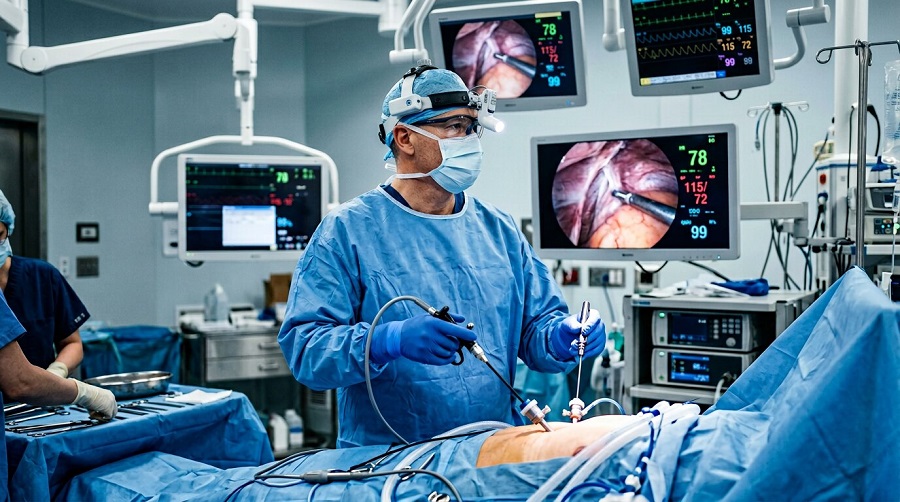
Video-Assisted Thoracoscopic Surgery, widely known as VATS, has transformed thoracic surgery over the past two decades. By allowing surgeons to operate through small incisions using a camera and specialised instruments rather than opening the chest in the conventional sense, VATS significantly reduces surgical trauma and supports faster recovery. Mr Scarci has been an active proponent of this approach, having performed over 5,000 minimally invasive procedures throughout his career. His participation as course director of the 2nd Cambridge International VATS Symposium reflects his standing in this area and his active role in shaping how the technique is taught and adopted.
He has demonstrated a particular interest in the development of uniportal VATS, a refinement of the technique that uses a single incision of approximately three centimetres rather than two or three ports. This evolution in surgical approach requires a higher level of technical skill but offers the potential for further reductions in post-operative discomfort and scarring. The practical benefits for patients include shorter hospital stays, quicker return to normal activity, and reduced risk of certain post-operative complications, making Mr Scarci's investment in this technique clinically relevant to the populations he treats.
Academic Output and Contributions to the Field
Research, Publications, and the Science Behind the Practice
The academic dimension of Mr Scarci's career is substantial. He has authored or co-authored over 200 peer-reviewed articles in the field of chest surgery, a volume of published output that places him among the more prolific surgical researchers working in the UK today. He has also contributed to four books on thoracic surgery, adding to the reference literature available to clinicians and trainees alike. This level of academic engagement is not incidental to his clinical work; it reflects a surgeon who remains connected to the evidence base that informs surgical decision-making and who contributes actively to its development.
His editorial and scholarly contributions extend beyond his own publications. He has served as guest editor for the Journal of Visualized Surgery on two separate special issues, one focused on pectus surgery and another covering the proceedings of the Cambridge International VATS Symposium. These roles position him at the intersection of clinical research and surgical communication, helping to disseminate technical and scientific findings to a broader professional audience. His membership on the new technologies and innovation workgroup of the European Association for Cardiothoracic Surgery similarly reflects engagement with where the field is heading rather than where it has been.
Mr Scarci holds fellowship status with the American College of Chest Physicians (FCCP), the American College of Surgeons (FACS), and the European Board of Thoracic and Cardiovascular Surgeons (FEBTS), each of which carries its own set of professional and academic requirements. He presents regularly at regional, national, and international meetings, including sessions at the Royal Society of Medicine and the Royal College of Surgeons of England, maintaining an active presence in surgical discourse across multiple forums.
What Patients Say About Their Experience
Communication, Clarity, and the Consultation Process
Patient review data provides a useful, if partial, picture of how Mr Scarci's clinical approach translates to the consultation room. His overall rating on Doctify stands at 4.93 out of 5 stars based on published reviews, and he carries a similarly strong profile on Top Doctors, where reviewers have described initial consultations as thorough, unhurried, and informative. Reviews on the Cromwell Hospital platform echo comparable themes. These are consistently high scores across independent review channels, and the language patients use is notably consistent: they describe feeling heard, well-informed, and confident in the clinical reasoning they were offered.
Several patient accounts refer specifically to Mr Scarci's willingness to discuss procedures in technical detail and to engage with the practical concerns that patients bring into the consultation. This quality is not universal among surgical specialists, where the weight of clinical knowledge can sometimes create communicative distance. The feedback from patients who have undergone complex procedures suggests that Mr Scarci applies the same attentiveness in the consultation room that he brings to the operating theatre.
Teaching, Mentorship, and Global Surgical Influence
Training the Next Generation of Thoracic Surgeons
Mr Scarci's contribution to surgical education is a meaningful part of his professional identity. He has trained a significant number of cardiothoracic surgeons over the course of his career, and his trainees now hold consultant or specialist posts at institutions including the Cleveland Clinic London, Harefield Hospital, the Royal Brompton, and St Thomas' Hospital. The placement of trained surgeons at institutions of that calibre is a reasonable indicator of the standard of teaching being provided, and it suggests that the influence of his clinical approach extends well beyond his own direct patient care.
His interest in education is not confined to practical surgical training. He is currently pursuing a master's degree in medical education, having previously completed several courses in the field. This formal investment in understanding how surgeons learn reflects a considered approach to teaching rather than an informal one, and it positions him to contribute more systematically to how the next generation of thoracic surgeons develops its competencies.
He is actively involved with the worldwide cardiothoracic surgery network CTSNet, the Society of Cardiothoracic Surgeons, and the European Association for Cardiothoracic Surgery, where he holds roles within the education and surgical manpower workgroup. These professional affiliations provide a platform for knowledge exchange across borders and specialties, and they reflect a surgeon whose reach within the field extends considerably beyond his own clinical caseload.
A Career That Speaks Clearly for Itself
For anyone navigating a thoracic diagnosis or seeking a specialist opinion on a complex chest condition, the profile of Mr Marco Scarci offers a coherent and well-documented foundation for confidence. His clinical record across lung cancer surgery, minimally invasive procedures, and chest wall conditions is extensive; his academic contributions are peer-reviewed and substantial; and the feedback from patients and colleagues reflects a practice that takes both technical and human dimensions of care seriously. He is not a surgeon whose reputation rests on a single area of distinction but rather one whose work across clinical, academic, and educational domains reinforces itself at every level.